

For many years, eCommerce has revolved around Google and SEO but now ChatGPT is here and GEO comes with it. The rise of generative AI is redefining how people discover and buy products and ChatGPT is leading the shift.
In October 2025, OpenAI introduced ChatGPT Product Feeds, a structured way for merchants to submit their product data directly to ChatGPT.
This marks a turning point for digital commerce: your catalog can now appear inside AI conversations, complete with titles, prices, images, and availability just like Google Shopping, but powered by conversational AI.
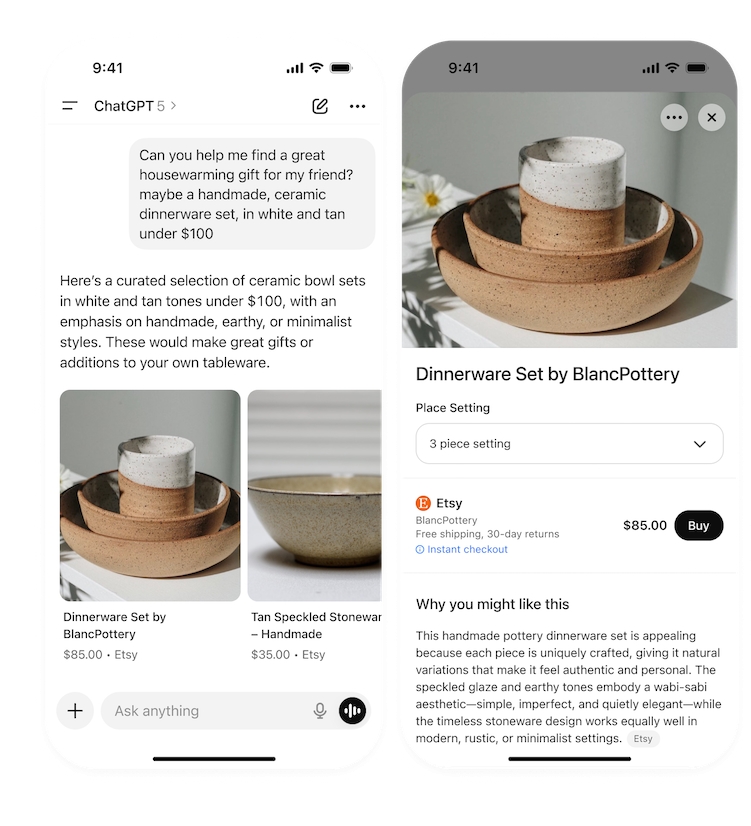
Demonstration of ChatGPT Shopping feature on mobile
1. What Is a ChatGPT Product Feed?
A ChatGPT product feed is a structured data file, typically in CSV, TSV, XML, or JSON format that contains your product catalog following OpenAI’s official Product Feed Specification.
It includes essential attributes such as:
id,title,description,price,availabilityimage_link,linkinventory_quantityenable_search,enable_checkout
OpenAI classify the differents field by types : OpenAI Flags, Basic Product Data, Item Information, Media, Price & Promotions, Availability & Inventory, Variants, Fulfillment, Merchant Info, Returns, Performance Signals, Compliance, Reviews and Q&A, Related Products, Geo Tagging
Once submitted, OpenAI validates and indexes the feed.
ChatGPT can then surface your products inside relevant conversations like:
“What are the best waterproof trail running shoes under $100?”
If your feed includes matching items, ChatGPT can display them directly showing product cards with accurate data pulled straight from your feed, not your website.
2. Why This Matters for SEO and E-commerce
This is the AI commerce revolution.
Just like Google Shopping transformed search visibility 15 years ago, ChatGPT feeds will define visibility in the era of conversational search.
For SEOs and marketers, this means:
- Structured data within product feed is now the foundation of AI discoverability.
- Visibility depends on feed optimization, accuracy, freshness, and clarity.
- Product descriptions must answer user intent, not just list specs.
ChatGPT doesn’t crawl your site to fetch your products. Instead, it trusts your feed as the source of truth. That makes feed optimization the new battle of SEO and GEO.
3.️ How to Submit Your Feed to ChatGPT
-
Register as a Merchant
Sign up at chat.openai.com/merchants (currently available in the US, expanding soon to Europe).
You’ll receive authentication credentials and endpoint details once approved. -
Prepare Your Feed
Supported formats include CSV, TSV, XML, and JSON.
The required fields include:
idtitledescriptionlink, image_linkprice, availabilityinventory_quantityenable_search
To enable in-chat checkout, you’ll also need:
enable_checkoutreturn_policyseller_privacy_policyseller_tos
-
Validate Your Feed
Before submission, test your feed for optimization : formatting, missing fields, and invalid URLs.
Of course, you can use SharpFeed to validate your ChatGPT feeds instantly. -
Automate Updates
OpenAI allows updates every 15 minutes, ideal for keeping pricing and stock accurate.
4. Key Fields and Optimization Tips
| Field | Description | Optimization Advice |
|---|---|---|
| title | The product’s main name | Keep it under 150 characters. Include color, size, and intent keywords. |
| description | Detailed product info | Aim for 300–500 words. Answer “who it’s for” and “why it’s great.” |
| price | Item price (with currency code) | Match website and feed prices exactly (79.99 USD). |
| availability | in_stock, out_of_stock, or preorder | Keep this accurate : ChatGPT hides unavailable products. |
| brand | Manufacturer or merchant name | Essential for credibility and filtering. |
| product_category | Taxonomy or custom category | Use precise hierarchy to aid AI matching. |
GEO Insight:
ChatGPT surfaces products contextually, not by keyword density. Write your data for conversational intent, not keyword stuffing.
5. Feed Optimization & GEO Strategy for ChatGPT
ChatGPT’s product feed schema introduces several unique attributes that enable richer, more adaptive AI-driven product experiences. Optimizing them strategically can improve visibility, engagement, and conversions.
video_link– adds visual context that increases engagement and helps ChatGPT recommend visually appealing products.model_3d_link– supports immersive 3D previews, ideal for tech, fashion, or furniture where scale and design matter.pricing_trend– helps ChatGPT understand price fluctuations over time, improving relevance for deal-seeking users.popularity_score– signals trending products, allowing AI to prioritize popular or best-selling items in recommendations.q_and_a– enables conversational answers to common buyer questions, aligning perfectly with ChatGPT’s dialogue style.raw_review_data– provides sentiment and feedback signals that strengthen trust and improve ranking relevance.relationship_type– clarifies associations between products (e.g., bundle, accessory, replacement), boosting cross-sell accuracy.geo_price– allows dynamic regional pricing, ensuring users see accurate local offers.geo_availability– indicates where products are in stock, helping ChatGPT display location-specific results.
GEO Insight:
Leveraging these advanced fields turns your feed from a static catalog into a dynamic conversational asset, one that adapts to user intent, geography, and engagement context.
6. ChatGPT vs Google Shopping: What’s Different?
| Feature | Google Shopping | ChatGPT Product Feed |
|---|---|---|
| Source of data | Crawled + Feed | Feed only |
| Update frequency | Daily or scheduled | Every 15 minutes |
| Discoverability | Based on search queries | Based on conversations |
| Checkout | Via Merchant Center | In-chat checkout (beta) |
| Ranking factors | CTR, bid, schema | Feed accuracy, relevance, freshness |
ChatGPT product feeds work like traditional Google Shopping feeds but follow a unique OpenAI schema with specific flags such as enable_search and enable_checkout.
They emphasize conversational optimization, meaning product titles and descriptions should perform well in natural-language searches within ChatGPT.
Unlike traditional crawled feeds, this push-based system gives merchants full control, allowing frequent updates for real-time accuracy and relevance.
ChatGPT’s ecosystem prioritizes trust and completeness : merchants who maintain clean, well-structured data will dominate AI-driven recommendations.
7. How SharpFeed Helps You Optimize for ChatGPT
If you already manage a Google Shopping feed, you’re 90% ready for ChatGPT.
But before submitting, your feed must pass a higher bar for clarity, structure and ChatGPT specificity.
That’s where SharpFeed helps.
- Detect missing / required ChatGPT unique fields
- Detect missing or invalid common fields (title, GTIN, availability, etc.)
- Check formatting (currency, date, measurement units)
- Evaluate SEO quality (length, clarity, keyword usage)
- IA Optimization (title rewrite, category analysis…)
You can upload your feed in CSV, TXT, or XML, and SharpFeed instantly audits and scores it, helping you fix issues before they block visibility in ChatGPT.
8.The Future of AI-Driven Commerce
As AI assistants evolve into shopping companions, feeds will power discovery, comparison, and checkout experiences across devices.
Expect upcoming innovations such as:
- Deeper platform integrations (Shopify, WooCommerce, BigCommerce)
- Conversational recommendations powered by your feed data
- Voice-based product discovery
Early adopters who master feed optimization today will lead in tomorrow’s AI commerce ecosystem.
⚡ Final Takeaway
ChatGPT Product Feeds aren’t just another integration : they’re the start of AI-native SEO.
Your feed is your storefront inside conversations.
Make it clean, structured, and optimized with SharpFeed.